
Indicators You Need a Yard Drainage System | A Guide with Questions & Solutions
In this guide, you will be able to determine whether your yard problems are indicators of a yard drainage problem. We will walk you step by step through identifying exactly what problems you are facing, what solutions there are, what solution fit your situation, and whether you need a professional, or are able to go DIY.
Why yard drainage is important
When excess water is apparent in a yard, there could be several negative consequences:
Foundational instability or collapse
Stunt in vegetation growth/death in vegetation
Mold, moisture, and floods in basements
Unappealing yard
Yard that is hard to walk on and use
These are only some of the negative consequences that come with a yard that holds excess water. To help you avoid any of these negative features, we have developed this guide to help you identify yard drainage problems, and solutions therefore.
Indicators of a yard drainage problem
As hardscaping professionals who have worked on drainage, we have found that many yard drainage problems lie in improper grading, soil compaction, and high ground water concentration,
As professionals in Massachusetts, where many homes already have drainage systems, we have seen how yard drainage problems can be caused by a drainage system malfunction or failure.
We have also seen how significant runoff water can be a factor in poor drainage along with low spots in the soil where water accumulates.
These yard drainage problems can be made obvious by various different types of indicators.
We have made a list of common indicators of a yard drainage issue, along with what specific issue these indicators might show.
The following are the indicators of a yard drainage issue:
Standing water
Standing water is one of the most obvious and common indicators of yard drainage problem.
Standing water is when liquid water accumulates on top of the soil in a yard and stays still, making it appear like that the yard has flooded.
However, standing water is quite normal, especially after heavy rainfall. But, standing water becomes abnormal if it stays for more than 24 hours, which indicates a standing water problem, and thus a yard drainage problem.

An image of standing water in a yard
With this, common yard drainage problems associated with standing water, is improper grading and high soil compaction.
Question: Do you have liquid water that is static on your yard surface: flooded yard? If so, has this water stood on your lawn for more than 24 hours?
If you have answered “yes” to the first question, you know you have standing water. If you have answered “yes” to the second question, you know you have a yard drainage problem associated with standing water; specific problem: improper grading or high soil compaction.
Foundation anomalies
Foundation problems are another very common indicator of some type of yard drainage problem.
Foundation anomalies are just abnormal features that your building’s foundation or basement inherits as a result of high water concentration near a building's foundation (particularly ground water).
These foundation anomalies can be cracks on the foundation, water stains/efflorescence on the foundation, or an uneven foundation (which may indicate a foundation sinkage).

An image of a crack on a home foundation
Water damage in the basement also acts as anomalies in your building’s foundation, such as high moisture levels, mold, peeling paints, leaks, and basement floods.
Many of these anomalies are commonly caused by hydrostatic pressure. This hydrostatic pressure is when the static weight of fluid and the weight of soil combine to inflict more lateral force/weight onto the foundation of a building.
This hydrostatic pressure can be very dangerous considering how it leads to a decrease in structural integrity. Hence why we advise to act quickly once any of these indicators are shown.
With this, common yard drainage problems associated with foundation anomalies are improper grading and high levels of ground water.
Question: Do you see any cracks or water stains/efflorescence on the foundation, or an uneven foundation? Has your basement experienced any high levels of moisture, mold accumulation, peeling of paint, leaks, or flooding?
If you answered “yes” to either one of these questions, then you know you have a yard drainage problem associated with your foundation; specific problem: improper grading or high ground water concentration.
Soggy yards
Soggy yards are another very common indicator of a yard drainage issue.
Soggy yards are yards that have very soft and mushy soil, like mud.
Common indicators of a soggy yard can be actually seen in the yard's vegetation. When water saturation in soil becomes high, this can prevent roots in the ground from receiving oxygen, therefore killing the plant. This is most commonly seen in grass, where grass will die in patches throughout the yard.
Common indicators of a soggy yard:
any sign of dying vegetation, such as discolorment or stalled growth
grass patches, muddy areas
moss/algae growth

An image of a soggy muddy yard
With this, common yard drainage problems associated with soggy yards are high ground water concentration, which is usually a cause of no drainage system or a malfunctioning one.
Question: Do you have any any sign of dying vegetation (such as discoloration or stalled growth), grass patches, muddy areas, or moss/algae growth in your yard?
If you answered “yes” to this question, then you know that you may have a yard drainage problem associated with a soggy yard; specific problem: high ground water concentration.
Soil erosion
Soil erosion is another common type of yard drainage issue.
Soil erosion is when soil (specifically top soil in this article) is displaced via water; when soil is moved from one area to another by water. This is not a sign of having drainage issues from rainfall, but rather issues from a different source that allows runoff water to enter your yard.
Common indicators of soil erosion caused by water:
Smooth carved out channels in the soil of your yard that water runs through; little stream lines of water canals in your soil

An image of soil erosion caused by water runoff
With this, yard drainage issues associated with soil erosion, is improper grading, or some source that allows water runoff, such as the roof of a home or rain gutter.
Question: Do you have any carved out channels in your soil?
If you answered “yes” to this question, you know that you have a yard drainage problem; specific problem: water runoff or improper grading.
Yard drainage system solutions
Now that you have identified that you do indeed have a yard drainage problem, and have identified possible reasons for the problem, we now have to explore solutions.
The following solutions are all yard drainage systems. We will explain what the drainage system is, how it works, the specific indicators it solves best, and if the drain can be made DIY.
Yard drainage system solutions comparison
Before we get into the specific of the yard drainage system, I have supplied a comparison list showing what each yard drainage system solution offers according to your problems and indicators:
Size of project (compared to eachother) | DIY difficulty (includes preparation) | Problems it fixes | Indicators that it is needed | |
French drain | Large | High-medium | All | All |
Surface drain | Medium | Medium | Standing water, low spots, run off | Standing water, soil erosion |
Dry well | Large | High-medium | All (assuming it is combined with another system) | All (assuming it is combines with another system) |
Downspout | Large | Very high | Run off | Soil erosion |
Downspout extension | Small | Very Low | Water damage on foundation | Foundational anomaly |
French drain
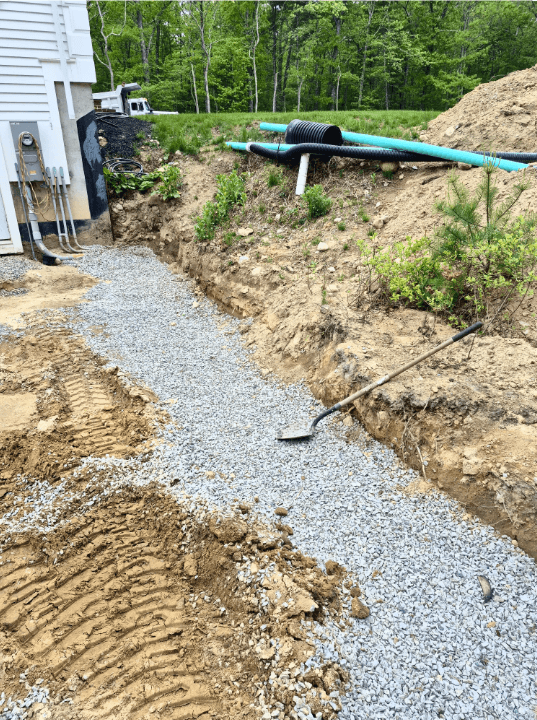
A french drain is a yard drainage system where a dug out trench has a french drain pipe (a pipe punctured with several mini holes and is wrapped with permeable fabric) within it, covered by usually gravel, which fills the entire trench. The trench is then covered by trench grates/covers or some hardscape such as a walkway (with crevices).

An image of a french drain in construction
How the french drain works is that it is placed near a highly water saturated area. Because the trench includes a cover that either has crevices or holes in it, rain water can enter the trench directly. Water may also enter the trench indirectly in the form of ground water as well. Since the trench is filled with gravel, water will navigate vertically down the trench until it reaches the french drain pipe. Since the french drain pipe is punctured with little holes, the water will go through the holes and enter the pipe. Now, by the force of gravity and water’s tendency to go on the path of least resistance, since the pipe is at a slope (going downhill inside the trench), the water will go down the pipe and into the drainage deposit area.

A diagram of how a french drain works
The french drain is most commonly used to collect ground water and get rid of standing water. Hence french drains are usually used when soggy yards and standing water indicators have been identified.
However, the french drain could also be used for the runoff, hence the soil erosion indicator, where you may put a french drain where the water channels are created by the runoff.
French drains may also be used to redirect water from the foundation of a building, hence the foundational anomaly indicator, where you may install a french drain around the foundation of the home.
Are french drains DIY
French drains are most certainly a DIY worthy project.
However, french drains do need proper preparation and research in order to succeed.
On top of this, we highly suggest that if your french drain project is large (the trench needs to go deep or the trench needs to be made long), to hire a professional. Especially if you are not willing to rent any machinery.
Surface Drains
Surface drains, otherwise known as a catch basin, is a yard drainage system where a grate is installed on the ground of the yard (or patio, or driveway), and is connected to a underground pipe.

An image of a surface drain in a yard
How the surface drain works is that it is installed in low spots on the yard or areas prone to flooding. What happens as a result is that when water begins to flood, the water will be deposited through the grate or cover of the surface drain, into the pipe it is connected to, where the water will be disposed of.

A diagram of how a surface drain works
With this, surface drains are commonly used for standing water, or low spots in yard where water floods, hence the standing water indicator.
However, surface drains are also great for water runoff, hence the soil erosion indicator, where the surface drain may be put somewhere along the channel of the water runoff.
Are surface drains DIY
Surface drains are certainly a DIY friendly project.
We suggest to hire a professional when the project becomes complex, or too large.
Dry well
A dry well is a yard drainage system where a large plastic or concrete container is installed underground, forming a chamber, where little holes are punctured through each container side. Depending on the situation, there may be a pipe that leads into the container to discharge water, or a surface drain may be placed above the dry well.
How the dry well works is that either water from another drainage system, such as that of a french drain, is discharged into the dry well container. Or, water from a surface drain, or surface drain pipe. Since the container is punctured with little holes, water can seep into the soil around the container slowly.

A diagram showing how a dry well works
With this, a dry well is commonly used for standing water or high ground water concentration, hence soggy lawns and standing water indicators.
However, since the dry well can be the discharge location of water for other drainage systems, it can be combined with the french drain or the surface drain pipe, and thus be used for any of the indicators.
Are dry wells DIY
Dry wells can be a DIY project. However when the dry well becomes a complex or large project (espeacally when dealing with concrete and excavation), or when the dry well is combined with other drainage systems, we highly suggest hiring a professional.
Downspout & downspout extensions
A downspout is a yard drainage system where a long vertical pipe that runs down the side of a building is connected to a gutter structure that surrounds that building just under the roof.

An image of a downspout
The downspout extension is essentially an extension placed at the end of the downspout system, where a tube essentially redirects the downspouts discharge farther away from the foundation of the building.

An image of a downspout extension
A downspout works by a gutter being placed just under the roof, where it collects the runoff water from the roof. This water then flows around the gutter until it reaches the downspout, where water falls vertically down the vertical tube and is safely discharged to ground.
A downspout extension works by installing a tube that is connected to the downspout tube’s exit hole (where the water is discharged). The water will enter this new tube which is aimed away from the building foundation, and the water will be discharged therefore.
A downspout is great at redirecting or controlling water runoff from roofs, hence the soil erosion indicator (assuming the runoff source is the roof of a building).
A downspout extension is great at redirecting water runoff from the foundation of a building, hence the foundation anomaly indicator.
Are downspouts DIY
Downspouts are not generally considered to be DIY especially if you install the gutter system above the roof as well.
We highly suggest hiring a professional to install a downspout or gutter system
Are downspout extensions DIY
Downspout extensions are very DIY friendly.
We actually highly suggest attempting to do a downspout extension alone, with proper research.
Choosing a Yard drainage system solution
When it comes to choosing a yard drainage system solution, you must consider a few metrics: The size of the project, DIY difficulty, what problems you are facing, and budget:
Size of project (compared to eachother) | DIY difficulty (includes preparation) | Problems it fixes | Indicators that it is needed | Budget (1=highest) | |
French drain | Large | High-medium | All | All | 1 |
Surface drain | Medium | Medium | Standing water, low spots, run off | Standing water, soil erosion | 4 |
Dry well | Large | High-medium | All (assuming it is combined with another system) | All (assuming it is combines with another system) | 2 |
Downspout | Large | Very high | Run off | Soil erosion | 3 |
Downspout extension | Small | Very Low | Water damage on foundation | Foundational anomaly | 5 |
Size of project
When considering which yard drainage system to install. You must consider the size of our project.
Generally, if any of these yard drainage systems in terms of the literal size of the drainage system, become large (besides the downspout extensions), it is suggested by general landscapers along with us at Cione’s, to not attempt to try the project alone. This is due to a worry in the amount of manual labor, worry in renting new machinery, and a worry in unexpected mistakes.
Now, yard drainage systems that are large in terms of preparation and effort (which is how we ranked the chart above), we would rank each system as the following:
French drain:
Dry well. This is due to the amount of research, resources (including possible machinery need), and manual labor needed. However, if you are installing a drywell along with other systems that connect to it simultaneously. Then Dry wells obviously would be ranked first.
Downspout. This is due to the experience needed with downspouts and gutters.
Surface drain. This is due to the simple research that is needed to be done along with the few resources and material needed.
Downspout extension. This is due to the need of no research, no resources, lack of high labor, and the need for only one material (which is the downspout extension itself)
DIY difficulty
When it comes to deciding what drainage system to get, you must determine whether you need to hire a professional, or if you should go DIY.
DIY difficulty is very dependent on the size of the project, both in the literal size of the drainage system, and preparations and efforts needed for the drainage system.
The DIY difficulty for each yard drainage system is ranked as the following:
Downspout. This is due to the experience and knowledge needed with downspouts with as well the safety concerns with the project.
French drain. This is due to the amount of research, materials, resources (including possible machinery need), and manual labor needed along with how large the project can get.
Dry well. This is due to the amount of research, resources (including possible machinery need), and manual labor needed. However, if you are installing a drywell along with other systems that connect to it simultaneously. Then Dry wells obviously would be ranked first.
Surface drain. This is due to the simple research that is needed to be done along with the few resources and material needed.
Downspout extension. This is due to the need of no research, no resources, lack of high labor, and the need for only one material (which is the downspout extension itself)
What problems you are facing
The problems you are facing on the yard is of course one of the most important things to consider when it comes to choosing your yard drainage system.
If you have not already determined what problems you may be specifically facing and indicators therefore, review the first section of this blog.
Standing water
If you are facing improper grading or high soil compaction, you may be subject to a standing water indicator
Yard drainage systems best for standing water are:
Surface drain
Dry well (when it is combined with other drainage systems, dry well ranks first)
French drain
Foundational anomaly
If you are facing improper grading or high levels of ground water, you may be subject to a foundation anomaly indicator.
Yard drainage systems best for foundational anomalies are:
French drain
Downspout extensions
Soggy yard
If you are facing high ground water concentration, you may be subject to a soggy yard.
Yard drainage systems best for soggy yards are:
French drain
Dry well
Soil erosion
If you are facing water runoff, you may be subject to soil erosion.
Yard drainage systems best for soil erosion are:
Downspouts
Budget
Another consideration to make when choosing your yard drainage system is your budget.
Realistically, budgets can vary drastically, especially when the project gets larger size. Hence, we ranked budget off of logic, considering material and resources.
If you are planning on hiring a professional, this ranked list may vary even more.
The following is the ranking for the highest budget needed to the lowest budget needed:
French drains
Dry well
Downspout
Surface drain
Downspout extension
What Cione’s Hardscape & Masonry offers
No matter what drainage system you need, our drainage & grading construction and design services can fulfill any one of your needs or desires (https://www.hmciones.com/service), while also giving you a satisfactory experience, with discounts and benefits along with exceptional pricing for you.
We are eager to relieve you of your landscaping burdens, and aid you in your landscaping desires:
Get Your Free Estimate at (857-251-1087) or (h.m.ciones@gmail.com) or our online form (do not hesitate to contact us with any questions concerning our services and specialties).
For more information concerning drainage and grading, whether it be construction, design, or tips, check out more of our articles (https://www.hmciones.com/guides)