
Retaining walls: types & ideas | what to choose
Retaining walls can come in many types and designs. Today, whether you are planning on choosing a retaining wall to add to your property, or are just curious, we will be going over the definition, types, and ideas for retaining walls.
What are retaining walls
Retaining walls are a structure (wall) that obstructs the natural slope of earth; countering the lateral pressure of the slope - or the force asserted onto the retaining wall by the slop.
Retaining walls are usually used for the following purposes: prevent erosion, improve drainage, create a terrace, as a landscape feature, or other purposes.
Types of retaining walls
Retaining walls in this guide will be identified by the following two properties: structure and material.
Types of retaining wall structures
There are four main types of retaining walls: Gravity, cantilever, anchored, and Mechanically Stabilized Earth (MSE)
Gravity walls
Gravity walls are a common type of retaining wall for most residential properties.
These walls are mainly used for raising beds or creating terraces, with added erosion control.
placed partially underground, the wall uses only its own weight (mass and gravity) to withstand the lateral force exerted by the soil behind it.

However, due to this nature, gravity walls are only limited to about four feet before they may be susceptible to collapse.
Despite this, Gravity walls are great since they can be made out of a variety of materials, they are DIY friendly, and require little maintenance.
Cantilever walls
Cantilever walls are another common retaining wall, used a lot for high stable bed raising, and high-load erosion.
An L-shaped wall is placed partially underground, where the (toe or heel) slab is placed under all of the soil’s weight, acting almost like an anchor, to keep the main wall (stem) in place, along with already the stem’s own weight.

Essentially a gravity wall, where the mass is increased by the use of a slab carrying the weight of the soil.
These walls can typically be built all the way up to twenty-five feet, being completely stable and reliable while requiring only checks every other year.
However, this wall in order to be DIY friendly, would need a person who is already experienced in engineering.
Anchored walls
Anchored walls are a common retaining wall used most to prevent high load erosion, and create very stable terraces.
Anchored walls may be used when an over a twenty feet wall is needed, when there is limited space, or when the soil is soft.
Supported independently by an anchor, the retaining wall stays in place by using cable tension, provided by the anchor behind it within the soil.

Anchored walls as suggested above are great when there is a need for height and great stability.
However, Anchored walls are complex and require good engineers and a construction team. Along with this, anchored walls require a good amount of maintenance.
Mechanically Stabilized Earth (MSE)
MSE walls are another common retaining wall type used commonly for its natural look, great prevention of erosion, and preservation of even the steepest of slopes.
Created from a variety of different materials, a large compact artificial barrier is made with inner reinforcements (usually steel strips).
Where, veneers, panels, or slabs are then pasted onto the outside of the barrier.
This design primarily relies on its weight (mass and gravity) and its reinforcements within, to keep it in place.

Essentially a gravity wall with inner reinforcements.
MSE walls are as stated above, great for when tall and stable structures are needed. To add on they can be constructed fast; great for on demand.
However, MSE walls are not DIY friendly and are usually more expensive.
Retaining wall type structure comparisons; what structure of retaining wall type to choose
For those of you who are deciphering which type of retaining wall to choose from, or are just interested in the similarities of these walls, I have made a comparison chart.
Height (1=best) | Steepness (1=best) | DIY potential (1=best) | Cost (1=best) | Construction speed (1=best) | |
Gravity walls | 4 | 3 or 4 | 1 | 1 | 2 |
Cantilever walls | 2 | 3 or 4 | 2 (caution) | 2 | 3 |
Anchored walls | 1 | 2 | No potential | 3 | 4 |
MSE walls | 3 | 1 | No potential | 4 | 1 |
For those interested in DIY, I would focus on the gravity walls and the cantilever walls. Although, be cautious with cantilever walls for as though feasible via DIY, it is best to consult an engineer.
Type of retaining wall material
Retaining walls can also be classified by their materials. Here are some summaries of the four main types of retaining wall materials, all judged by their strength, durability (includes weather resistance), aesthetic, cost, and DIY potential.
(Note that maintenance is a quality that no matter the material, should be periodic when it comes to retaining walls).
Before continuing on with this section: the costs written were taken from Haley Nothstein article on Angie. For updated prices, refer to her article at How Much Does It Cost to Build a Retaining Wall? [2026 Data] | Angi
Concrete

Concrete retaining walls are retaining walls made from either poured concrete, or stacked concrete slabs.
Concrete, a mix of cement with other materials, is generally known to be one of the strongest of artificial materials.
Hence, these concrete retaining walls are one of the strongest out of the retaining walls due to their great strength and durability in even harsh climates.
These walls are also great for neutral, minimal, and modern designs, while still being quite DIY friendly.
However, concrete compared to the other materials in this list, is generally more expensive at about $30-$50/square foot according to Nothstein’s article on Angie.
Stone

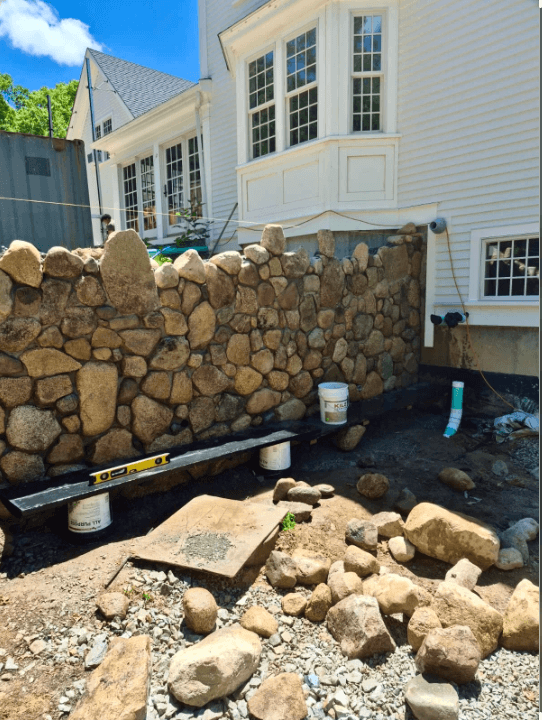
The image above is of an actual stone retaining wall project from Cione's Hardscape and Masonry.
Stone retaining walls are another type of retaining wall that uses stone.
Stone is the strongest of materials in this list due to its natural qualities of its great strength and weather resistance.
For this, stone retaining walls are the strongest and most durable out of the other retaining walls.
Stone retaining walls also give a more rustic aesthetic, which may be a great benefit to those who enjoy such styles.
However, without at least a proper understanding of stone arrangement and building, stone retaining walls are not as DIY friendly as that of the concrete.
On top of this, stone retaining walls can get to very expensive prices, at $20-$100/square feet according to Nothstein’s article on Angie.
Brick

Brick retaining walls are a type of retaining wall that uses brick.
Brick, being a clay mold mixed with several other materials, is not as strong or durable as that of concrete or stone.
For this, brick retaining walls are not great for when strength or durability is needed, unless combined with stone or concrete (although, great strength is still absent) which is not uncommon.
These retaining walls are also not very DIY friendly unless at the very least the person knows brick arrangement and building.
However, for those who enjoy more classical and welcoming styles, brick retaining walls are a great choice, especially when combined with stone or concrete in terms of aesthetic.
Brick retaining walls are also quite less expensive compared to that of the concrete or stone, with $20-$25/square foot according to Nothstein’s article on Angie.
Timber

Timber retaining walls are retaining walls made from timber.
Timber, no matter the type, is generally a weaker and less durable material compared to that of stone, concrete, and brick.
(Though, timber when waterproof, depending on the type, can last up to 20 to 40 years).
However, timber can give you an excellent natural and welcoming aesthetic.
Timber is also very DIY friendly, perfect for those not equipped with much experience or for those who do not want to handle complex techniques or material.
On top of this, timber is generally less expensive than that of the materials above, at about $15-$30 according to Nothstein’s article on Angie.
Comparing retaining wall materials; what retaining wall material type to choose
For those choosing which retaining wall material to choose, or are interested in how these materials can be compared, I have made a chart illustrating the qualities of each material by strength, durability (includes weather resistance), aesthetic, cost, and DIY potential.
Strength | Durability | Aesthetic | High cost (sq/feet) | DIY potential | |
Concrete | 2nd | 2nd | Neutral | 2nd ($30-$50) | Good |
Stone | Greatest | Greatest | Rustic | Highest($20-$100) | Depends on preparation |
Brick | 3rd | 3rd | Classic | 3rd ($20-$25) | Depends on preparation |
Timber | Least | Least | Natural | Lowest ($15-$30) | Great |
Ideas for a retaining wall
There are several ideas that you can execute, to make your retaining wall or walls more aesthetically pleasing.
Hence, here are seven different ideas that can significantly enhance your retaining wall.
Hierarchy
Hierarchy in retaining walls refers to the different levels that two or more retaining walls cana take relative to each other.
Including a hierarchy in your retaining wall will enhance the visual structure of the retaining wall, making it look more appealing and elegant, while also offering more depth, in which we naturally find appeal in.
Hierarchy also allows you to be able to include features such as a garden bed or unique lighting, which can further enhance the aesthetic.

Curves
Curves in a retaining wall, is a curve in the layout of the retaining wall. This wall layout can enhance the aesthetic of the wall, not only adding more depth that are eyes love, but also creating a welcoming atmosphere.

Capstones
Capstones on a retaining wall are the little slabs that sit on top of the wall. These are great as they put more depth and structure to the wall, making it more appealing to our human minds that love pattern and completeness.
It is also good to mention how these capstones can be used for sitting or placing items on; great for around campfires or patios.

Garden beds
Garden beds are little gardens or areas, filled with plants or flowers, being a great addition to retaining wall, adding a whole new layer of aesthetic and feeling.
Garden beds are also an opportunity to get into gardening, whether it be a hobby, or actually producing food for either yourself or outside animals to eat.

End posts
End posts, also known as king posts, can be added to the end of a retaining wall in a variety of different formations. These end posts, especially when combined with capstones, will complete the wall, making its structure and appearance feel satisfying and appealing, with more unique structures to look at.

Patio
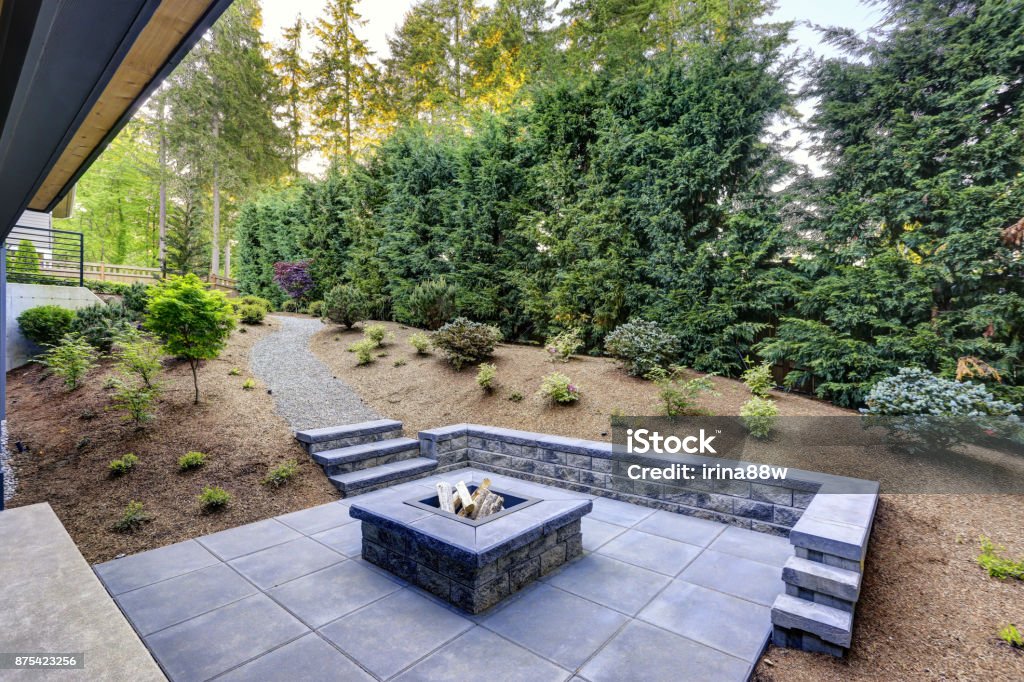
Many people think of retaining walls as an addition to a patio when in reality, it can be the element in the landscape that opened the opportunity to install the patio in the first place.
Hence, if you have the opportunity, especially with retaining walls that have capstones, a patio would be a great aesthetic to add to the environment while also being a functional element.
Material aesthetic
Retaining walls can be made out of a few different types of materials, with four main ones being listed in the (types of retaining walls) section, and depending on the material, the retaining wall can take on a variety of different aesthetics and looks.
Concrete
Concrete retaining walls as mentioned before, concrete can give you a neutral, minimal, or in some instances a more modern look and aesthetic.

Stone
Stone retaining walls as explained before, can take on a natural and welcoming feel and aesthetic.

Brick
Brick retaining walls can offer you a very classical look as talked about before, but brick can also offer you a very welcoming look and aesthetic as well.

What Cione’s Hardscape & Masonry offers
No matter the type of retaining all you want, or the ideas that you want to execute, our walls and retaining walls construction and design services can fulfill any one of your needs or desires, while also giving you a satisfactory experience, with discounts and benefits along with exceptional pricing for you.
We are eager to relieve you of your landscaping burdens, and aid you in your landscaping desires:
Get Your Free Estimate at (857-251-1087) or (h.m.ciones@gmail.com) or our online form (do not hesitate to contact us with any questions concerning our services and specialties).
For more information concerning retaining walls, whether it be construction, design, or tips, check out more of our blogs.